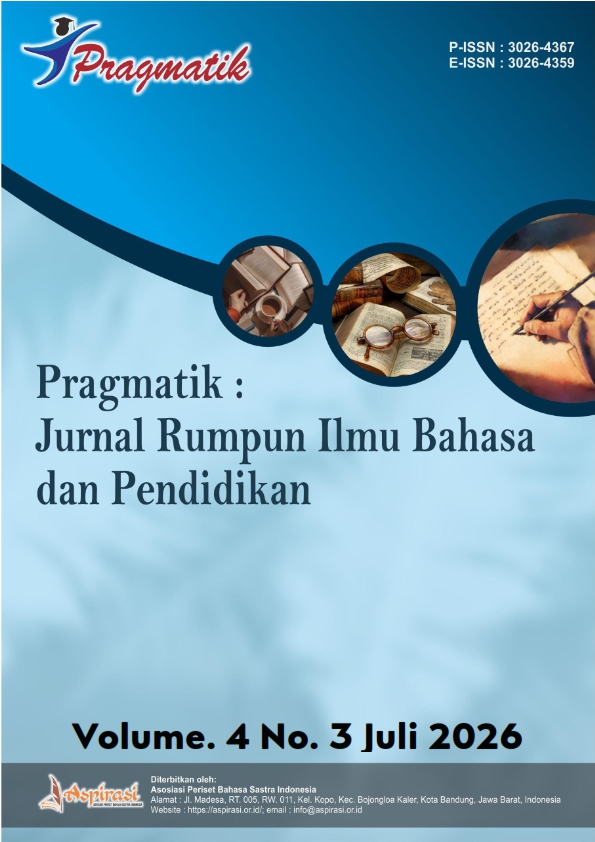
Tindak Tutur Ekspresif dalam Film Raya and the Last Dragon
DOI:
https://doi.org/10.61132/pragmatik.v4i3.2777Keywords:
Context, Expressive Acts, Illocutionary Acts, Pragmatics, Unity Creates PeaceAbstract
This study aims to describe the types of expressive speech acts uttered by the character Raya in the film Raya and the Last Dragon. This study applied a pragmatic approach, focusing on speech act theory and context to understand the meaning of the utterances made by the character in various communicative situations. The method used is a descriptive qualitative method. The research data consists of Raya’s utterances containing expressive speech acts in the film Raya and the Last Dragon. Data collection was conducted through observation and note-taking while data analysis involved identifying, classifying, and describing the utterances based on the type of expressive speech act and the underlying context. The results of the study indicate that there are eleven types of expressive speech acts used by the character of Raya, namely gratitude, admiration, enthusiasm, surprise, worry, disappointment, anger, panic, apology, hope, and regret. Raya uses these expressive speech acts to convey various psychological states that arise in response to events, conflicts, and interactions with other characters
Downloads
References
Austin, J. L. (1962). How to Do Things with Words. Oxford University Press.
Faradilla, A. N. (2024). TINDAK TUTUR DAN FUNGSI EKSPRESIF DALAM SERIES PEAKY BLINDERS SEASON SATU. PROSIDING SEMINAR NASIONAL LINGUISTIK DAN SASTRA (SEMNALISA), 378–386.
Hall, J. K. (2002). Teaching and Researching Language and Culture. Pearson Education Limited.
Halliday, M. A. ., & Hassan, R. (1989). Language, Context, and Text: Aspects of language in a social-semiotic perspective. Oxford University Press.
Leech, G. N. (1983). Principles of Pragmatics. Longman.
Levinson, S. C. (1983). Pragmatics. Cambridge University Press.
Miles, M. B., Huberman, A. M., & Saldana, J. (2014). Qualitative Data Analysis A Methods Sourcebook (Third Edit). SAGE Publications, Inc.
Rahardi, R. K. (2005). Pragmatik Kesantunan Imperatif Bahasa Indonesia. Erlangga.
Ruhiat, R. R., Insani, A. N., Nisrina, A. L., Ermawati, & Utomo, A. P. Y. (2022). Analisis Tindak Tutur Ekspresif dalam Film “Nanti Kita Cerita Tentang Hari Ini” Karya Angga Dwimas Sasongko. Khatulistiwa: Jurnal Pendidikan Dan Sosial Humaniora, 2(2), 113–128.
Searle, J. R. (1969). Speech Acts: An Essay in the Philosophy of Language. Cambridge University Press.
Shelviana, D. M., & Mulatsih, S. (2022). Expressive and Directive Speech Acts in Peter Parker’s Conversation in the Movie Spider-Man 3. Undergraduate Conference on Language, Literature, and Culture, 2(1), 66–75. http://publikasi.dinus.ac.id/index.php/unclle
Sudaryanto. (2015). Metode dan Aneka Teknik Analisis Bahasa. Universitas Sanata Dharma.
Sukmawan, R. (2018). Kajian Penolakan dalam Lingkup Linguistik. UMMIPress.
Sukmawan, R., & Supendi, D. A. (2016). Structural Presupposition in Wayang Golek. Journal of Applied Linguistics and Language Research, 3(7), 123–131.
Verhaar, J. W. . (1999). Asas-Asas Linguistik Umum. Gadjah Mada University Press.
Wijana, I. D. P. (1996). Dasar-dasar Pragmatik. Andi Offset.
Yule, G. (1996). Pragmatics. Oxford University Press.
Downloads
Published
How to Cite
Issue
Section
License
Copyright (c) 2026 Pragmatik : Jurnal Rumpun Ilmu Bahasa dan Pendidikan

This work is licensed under a Creative Commons Attribution-ShareAlike 4.0 International License.