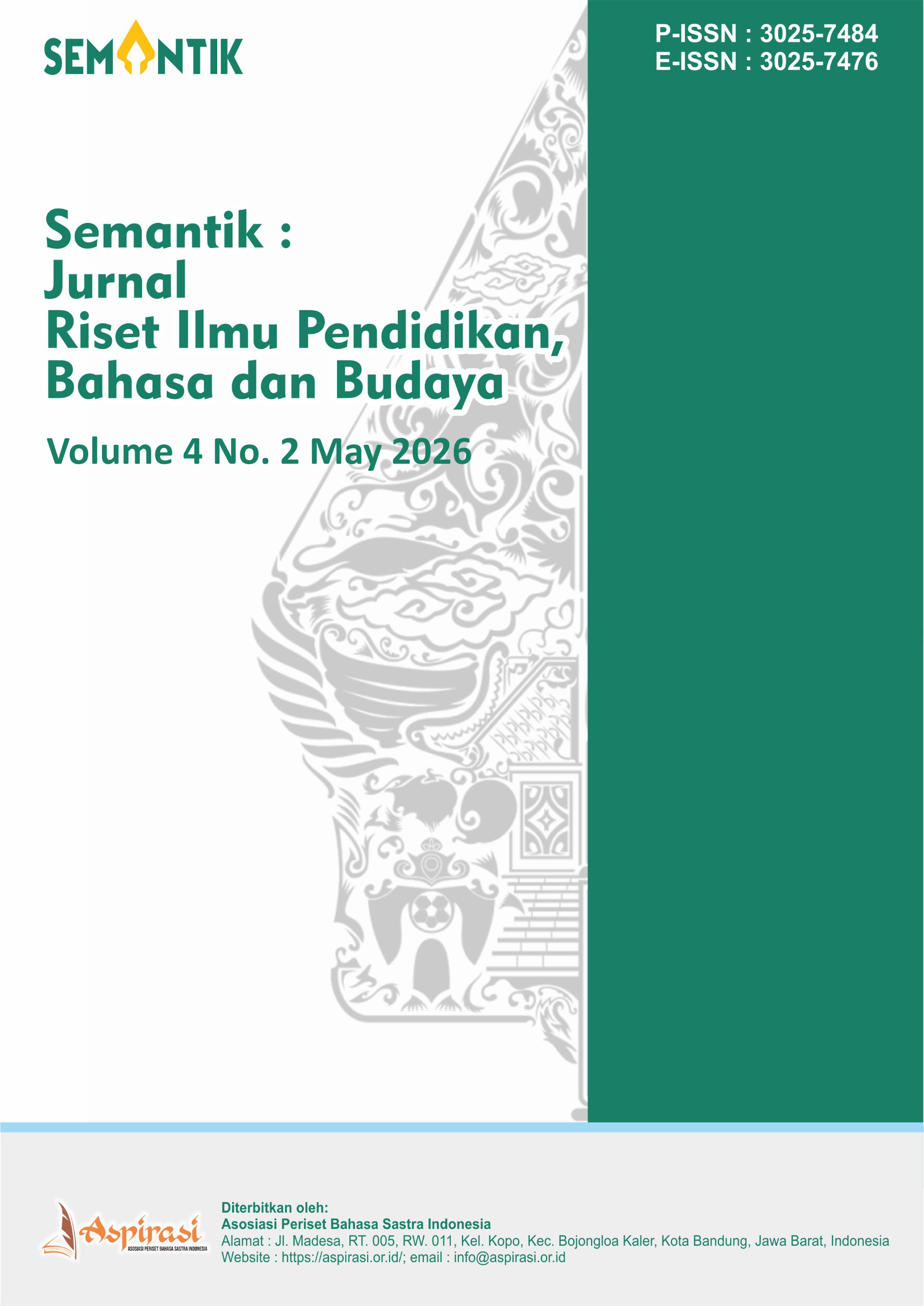
Makna Budaya dalam Slogan Demonstrasi Mahasiswa: Kajian Antropolinguistik
DOI:
https://doi.org/10.61132/semantik.v4i2.2664Keywords:
Anthropolinguistics, Culture, Demonstration, Ideology, SloganAbstract
This study examines the cultural meanings contained in student protest slogans during the October 2025 demonstrations using an anthropolinguistic approach. Language in protest slogans functions not only as a communication tool but also as a cultural representation reflecting social values, ideology, collective identity, and social practices. The purpose of this study is to reveal the cultural meanings embedded in student protest slogans and explain how these meanings are constructed through linguistic choices. This research employs a descriptive qualitative method with observation, note-taking, documentation, and brief interviews with participants as data collection techniques. The data were analyzed using distributional methods by identifying linguistic elements such as metaphors, irony, lexical choices, and sentence structures, then relating them to socio-cultural contexts. The findings show that protest slogans represent values of social solidarity, nationalism, social justice, transparency, criticism of power, gender equality, and resistance to state repression. In addition, slogans construct collective identities between citizens, government, and authorities, while carrying strong socio-political ideologies. These findings confirm that protest slogans are complex cultural practices and reflect students’ collective awareness in responding to social dynamics.
Downloads
References
Austin, J. L. (1962). How to do things with words. Oxford University Press.
Blommaert, J. (2005). Discourse: A critical introduction. Cambridge University Press. https://doi.org/10.1017/CBO9780511610295
Bourdieu, P. (1991). Language and symbolic power. Harvard University Press.
Chomsky, N. (1965). Aspects of the theory of syntax. MIT Press. https://doi.org/10.21236/AD0616323
Creswell, J. W. (2014). Research design: Qualitative, quantitative, and mixed methods approaches (4th ed.). Sage Publications.
Duranti, A. (1997). Linguistic anthropology. Cambridge University Press. https://doi.org/10.1017/CBO9780511810190
Fairclough, N. (1995). Critical discourse analysis: The critical study of language. Longman.
Foley, W. A. (1997). Anthropological linguistics: An introduction. Blackwell.
Foucault, M. (1972). The archaeology of knowledge. Routledge.
Gee, J. P. (2011). An introduction to discourse analysis: Theory and method (3rd ed.). Routledge.
Halliday, M. A. K. (1978). Language as social semiotic: The social interpretation of language and meaning. Edward Arnold.
Hymes, D. (1974). Foundations in sociolinguistics: An ethnographic approach. University of Pennsylvania Press.
Kramsch, C. (2013). Language and culture. Oxford University Press.
Lakoff, G., & Johnson, M. (1980). Metaphors we live by. University of Chicago Press.
Sapir, E. (1921). Language: An introduction to the study of speech. Harcourt, Brace & Company.
Saussure, F. de. (1916). Course in general linguistics. McGraw-Hill.
Searle, J. R. (1969). Speech acts: An essay in the philosophy of language. Cambridge University Press. https://doi.org/10.1017/CBO9781139173438
Sudaryanto. (1993). Metode dan aneka teknik analisis bahasa. Duta Wacana University Press.
van Dijk, T. A. (2006). Discourse and power. Palgrave Macmillan.
Wodak, R., & Meyer, M. (2009). Methods of critical discourse analysis (2nd ed.). Sage Publications.
Downloads
Published
How to Cite
Issue
Section
License
Copyright (c) 2026 Semantik : Jurnal Riset Ilmu Pendidikan, Bahasa dan Budaya

This work is licensed under a Creative Commons Attribution-ShareAlike 4.0 International License.